2026 Energy Ministers' Conference: Cable laying for the DolWin4 & BorWin4 offshore grid connections
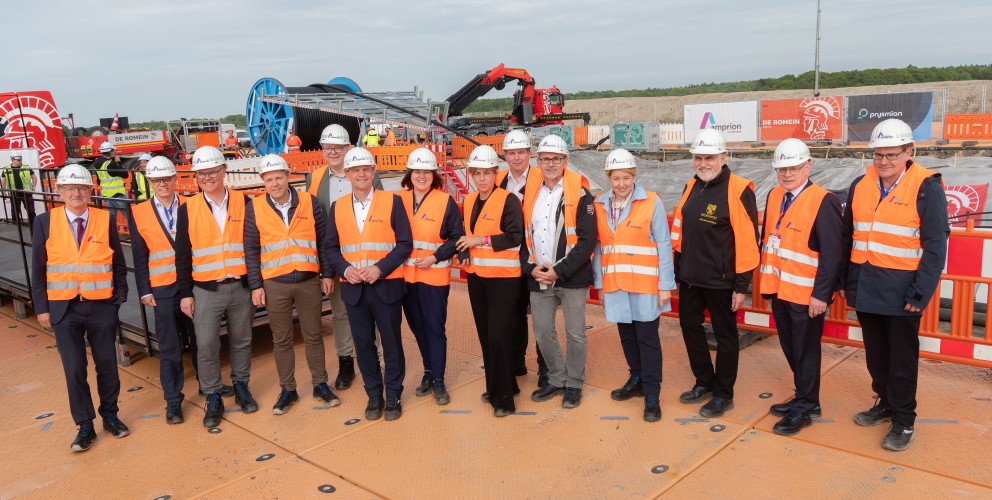
Electricity from the offshore wind farms is arriving on the East Frisian coast near Norden. The area is still a major construction site where the cables are being connected. On the sidelines of the energy ministers’ conference on the island, the energy ministers of the federal states visited the Amprion construction site on the coast.
Since last summer, major cable-laying work has been underway near the town of Norden for the DolWin4 and BorWin4 grid connection systems. The power cables come from the offshore wind farms, pass under Norderney, and run about 155 kilometers from the coast to Lingen in the Emsland region. Starting in 2028, offshore wind farms with a total capacity of 1.8 gigawatts will be connected to the grid via DolWin4 and BorWin4. During a site visit at the Energy Ministers’ Conference (EnMK), Christian Meyer, current EnMK chair and Minister for the Environment, Energy, and Climate Protection of the State of Lower Saxony, pitched in with the cable-pulling operation to pull the power cables into underground protective conduits.
“The energy transition toward affordable, climate-friendly, domestic renewable energy is working and is a tremendous joint effort by wind farm and grid operators and policymakers,” said Energy Minister Meyer. “Here on the North Sea, we are demonstrating how we can transport large volumes of wind power from the sea to consumption centers in the south, thereby contributing to climate neutrality, energy independence, and the replacement of fossil fuel imports. I thank everyone involved for implementing these major investments in connecting the offshore wind farms. It was important to me, during the Energy Ministers’ Conference on Norderney, to show my colleagues that we are ready for the energy transition throughout Germany and that we are implementing it together in an exemplary manner. We must now stay the course and reliably and predictably drive forward offshore expansion and grid connection in particular. Because with every transport of affordable offshore wind power via the cable routes to the south, we replace fossil fuel-fired coal-fired power plants, reduce the costs of grid bottlenecks, and contribute significantly to lowering electricity prices for businesses and households throughout Germany.”
Power lines carry electricity to 1.8 million residents
“We would like to thank the state of Lower Saxony for supporting us in expanding the infrastructure and paving the way to climate neutrality,” said Dr. Hendrik Neumann, Amprion’s Chief Technical Officer, during a visit to the construction site. “Thanks to the state’s support, we are bringing wind energy directly from the North Sea to Lingen in southern Emsland—the feed-in point for the Emsland nuclear power plant, which will be shut down in 2023.”
The city of Norden serves as a transit region for connecting the wind farms: From here, the cables run toward Norderney and south toward Lingen. Both connected wind farms have a capacity of around 900 megawatts each. The new lines will be able to transport around 1.8 gigawatts of power, thereby covering the electricity needs of nearly 1.8 million residents—roughly equivalent to the population of the Hanseatic City of Hamburg.
“By 2030, the capacity of installed offshore wind farms in Germany is set to rise to 30 gigawatts. This means the installed capacity of offshore wind farms will roughly match the output of 40 large coal-fired power plants,” explains Dr. Hendrik Neumann. “Our offshore grid connection systems, such as DolWin4, BorWin4, BalWin1, and BalWin2, make a major contribution to bringing green electricity ashore. In doing so, we reduce bottlenecks in the power grid and significantly lower costs for consumers in the medium term.”
Offshore Planning at Amprion
Germany aims to become climate-neutral by 2045 and is therefore focusing on expanding renewable energy—particularly offshore. The Offshore Wind Energy Act outlines the framework for the expansion of offshore wind farms: Capacity is set to rise to 30 gigawatts by 2030 and to 40 gigawatts by 2035. To this end, Amprion is investing approximately 42 billion euros by 2030 in the expansion of the transmission grid and thus in Germany’s energy transition. Of this amount, more than 16 billion euros will go toward offshore projects. This includes several high-capacity onshore and offshore projects using direct current technology, which are being bundled by Amprion. This approach saves time and costs while minimizing impacts on nature and the environment.
The offshore grid connections extend far inland to major consumption centers, ensuring that wind power reaches the very places where energy is most needed. In addition, converter platforms at sea are interconnected with one another and with European partners. Amprion is currently implementing offshore grid connections in the DolWin4 and BorWin4, BalWin1 and 2, Windader West, and Rhein-Main-Link projects