Technologies and Applications
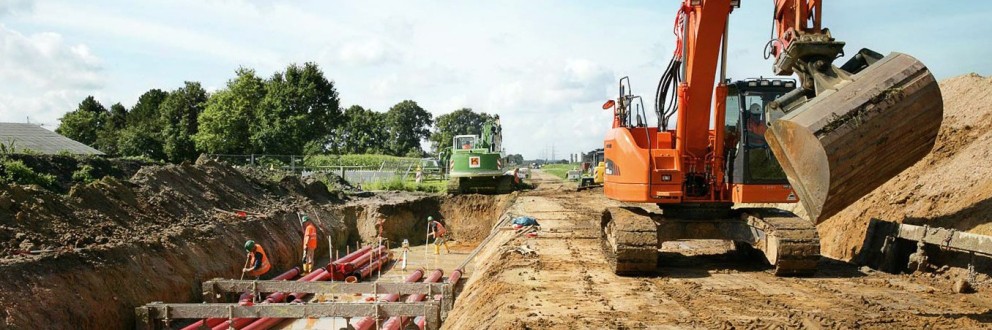
The term “cable” encompasses various technologies designed for different applications. Their use depends on the voltage level, transmission capacity, and distance, as well as whether the power is to be transmitted on land or at sea. The higher the demand and the greater the voltage, the more technically complex the underground cables and their installation become.
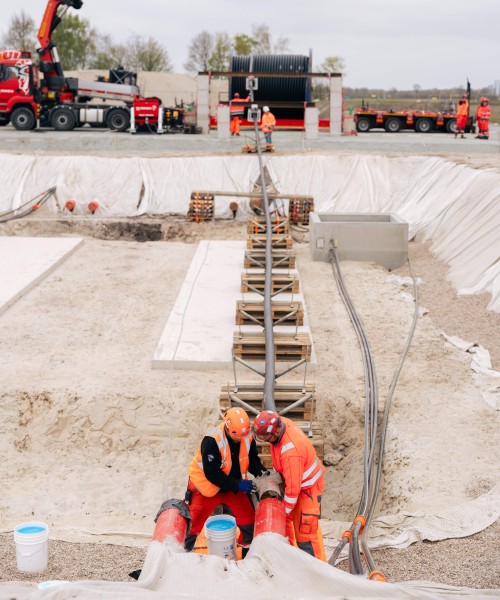
Extra-high voltage cables
Amprion’s transmission network transports very high demand levels over long distances. It supplies entire major cities and metropolitan areas. Overhead lines have been used in the AC grid for nearly 100 years. Cable systems have not yet been tested to the degree of completeness at this voltage level in the AC sector. In legally mandated pilot projects, we are gathering initial experience with partial cabling in the AC sector.
Direct current connections will complement and relieve our transmission network in the future. They offer particular advantages when transporting large amounts of energy over very long distances. The connection of offshore wind farms to the onshore power grid is also typically carried out using direct current. In the direct current sector, underground cables represent the state of the art.
AC Underground Cables
Underground cables have rarely been used in the AC sector at the extra-high voltage level—especially when high power demands need to be transmitted. This is due, on the one hand, to the high demand for reactive power. On the other hand, it is necessary to gain experience with the operation of underground cables in a tightly meshed AC grid. For this reason, we are investigating the operation of AC cables as part of pilot projects.
The Energy Transmission Line Expansion Act (EnLAG) designates six projects as pilot projects, while the Federal Requirements Plan Act (BBPlG) designates five. On these routes, transmission system operators may, under certain conditions, construct sections as underground cables and thus gather insights into the construction and operation of this technology. Amprion is implementing partial underground cabling for the projects Dörpen West – Niederrhein, Wehrendorf – Gütersloh, and Niederrhein/Wesel – Osterath.

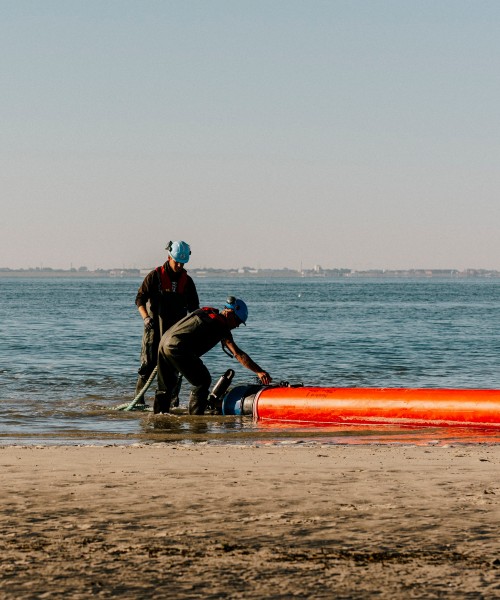
DC Subsea Cables
To date, DC cables have primarily been used at sea. For example, this technology is used in the North Sea to connect large offshore wind farms located far from the coast to the onshore transmission network. We are constructing our Energy Corridor A-North, Corridor B, and Rhine-Main Link as DC submarine cables in accordance with the legal framework. We are also implementing offshore grid integration systems such as BalWin1 and BalWin2 as DC submarine cables. DC connections require converter stations at both the starting and ending points. These convert direct current to alternating current and vice versa.
Energy Corridor
Our energy corridors typically bundle multiple DC systems. They transmit large amounts of energy over long distances with minimal losses using high-voltage direct current (HVDC) transmission. Bundling the lines into a single energy corridor can expedite permitting processes. In addition, bundling the lines minimizes land use and impact on the environment.
