Overhead lines

Das freundliche Bild im Querformat zeigt Masten und Freileitungen, welche vor einem Waldsaum von der rechten Seite des Bildes nach links laufen. Im unteren Drittel ein eine Rasenfläche zu erkennen, welche von einer Wildhecke begrenzt wird. Darüber ist fast blauer Himmel mit Cirruswolken zu erkennen.

An important part of our grid is the overhead lines, which consist of a total of approximately 20,000 pylons. These pylons support the conductors and are typically spaced 300 to 500 meters apart. The pylons are mostly constructed as steel lattice structures—a proven and cost-effective design that has therefore become the global standard.
Circuits and Cross-Arms

A typical overhead power line tower has one or more cross-arms. Insulators are mounted on these cross-arms, to which conductor cables are attached.. These are typically composite cables with a steel core and an aluminum sheath, which have different cross-sections depending on the transmission capacity. A common configuration for 380kV lines would be a four-strand bundle of four cables per phase.. Each circuit comprises three phases. An overhead line tower usually supports multiple circuits.

Insulators are now made of polymers, replacing older models made of porcelain, whileglass or ceramic are also being used. They isolate the high voltages of the overhead conductors from the grounded pylons and prevent current from being transmitted from the conductors to the pylons. Alightning protection wire runs from pylone top to pylone top.

Different designs of our pylons

Depending on local conditions, we use different types of structures for our overhead lines: barrel-shaped, single-level, and Danube-style pylons. These pole types differ in height as well as in the number and length of their crossarms. Hybrid structures with additional crossarms, are used to carry 110-kilovolt circuits.

Schematische Darstellung eines elektrischen Freileitungsmastes in grauer Strichgrafik auf weißem Hintergrund.
Barrel

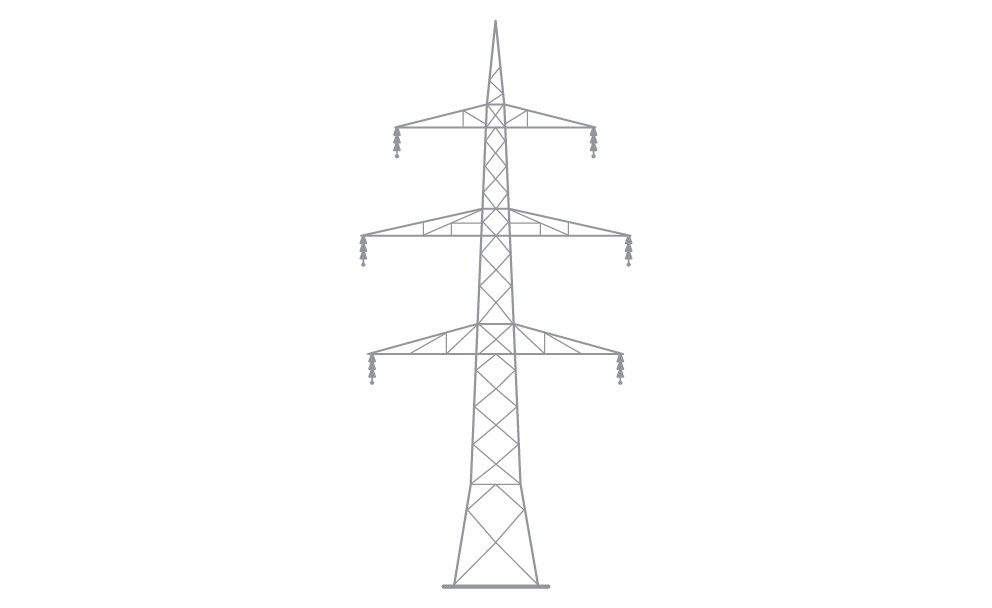
Barrel towers are three-level towers with the mid-level cross-arms being longer than the upper and lower cross-arms, giving the conductor arrangement a barrel-like shape. These towers usually carry two circuits. Their three phases are arranged one below the other. They are preferably deployed where the width of the route is restricted, such as when cutting through woods or forests.

Schematische Darstellung eines elektrischen Freileitungsmastes in grauer Strichgrafik auf weißem Hintergrund.
Single-level

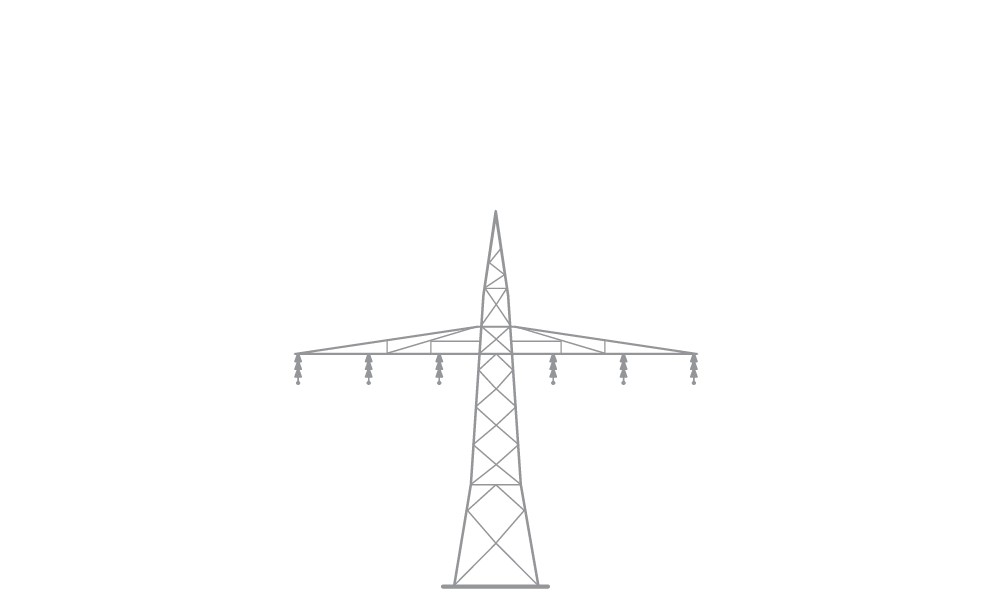
Single-level towers are equipped with one long cross-arm (with one beam on either side) and three phases on either side. These pylones are particularly short, yet require wide routes: they are commonly used in the vicinity of airports and airfields.

Schematische Darstellung eines elektrischen Freileitungsmastes in grauer Strichgrafik auf weißem Hintergrund.
Danube

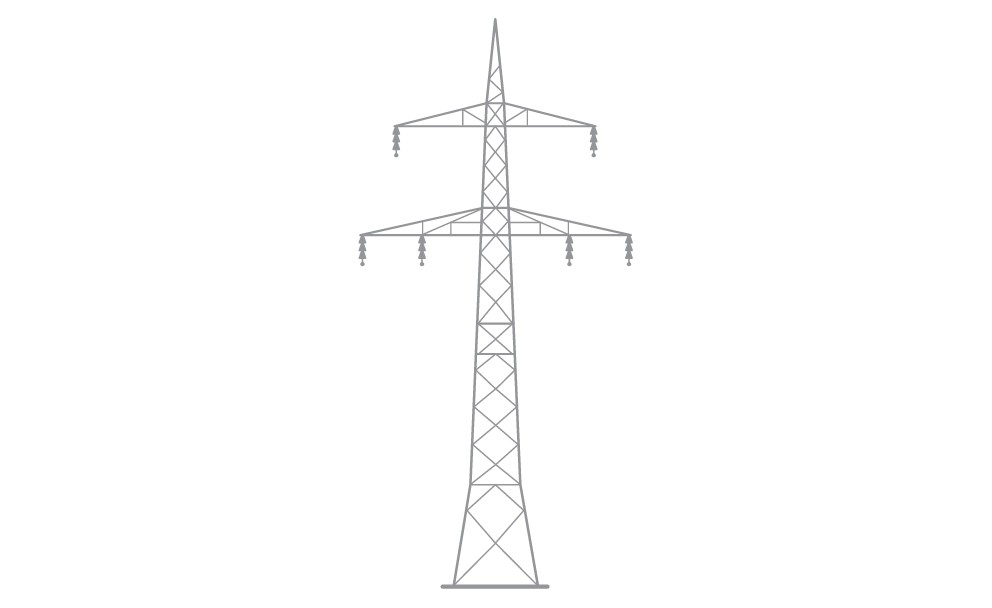
Danube towers are two-level towers. They typically carry one conductor bundle on either side on the upper level cross-arms and two bundles on each side on the lower level cross-arm; that is, one circuit on either side. This makes them shorter than barrel towers, and narrower than single-level towers.

Monitoring and Maintenance

We keep the grid in good working order, using helicopters to monitor it for signs of wear and tear and to initiate maintenance measures.