At Amprion, we combine the necessary expansion of our transmission grid with the consistent protection of nature and biodiversity. In doing so, we design our routes in such a way that new habitats are created, sensitive ecosystems are preserved and animals – particularly birds – are protected as effectively as possible.
Nature conservation
Grid expansion is essential for the success of the energy transition. It is the only way to achieve the climate targets of the EU and Germany. In doing so, the power lines pass through landscapes, forests and meadows, along coastlines and across waterways – thereby influencing various ecosystems. Amprion regards protecting these as an important part of its responsibility.
For more than 20 years, Amprion has played a pioneering role in the field of environmentally sensitive corridor management. This is based on a holistic approach: we take environmental aspects into account both during the planning stage and subsequently during the construction and operation of our power lines and facilities. At the heart of our operational commitment lies our ecological corridor management, which has evolved over the years and which we are constantly refining both internally and in consultation with key stakeholders. This has enabled numerous habitats to develop along the power line network, in which protected species are also able to settle.
Amprion relies on innovative technologies for electricity transmission, taking their environmental impact into account. This also applies to underground cabling, which preserves the landscape but in some cases requires extensive ground works.
Offshore power line construction is necessary to connect offshore wind farms to the transmission grid. Going beyond the legal requirements at EU, federal and state level, we take measures to protect the habitats in these areas. In the Wadden Sea National Park, for example, we follow the ‘zero discharge principle’. This means we leave behind nothing that does not occur there naturally. As part of marine conservation, we take wildlife into consideration. When installing converter platforms at sea, we intend to implement special noise protection measures to safeguard the highly sensitive hearing of marine animals such as porpoises.
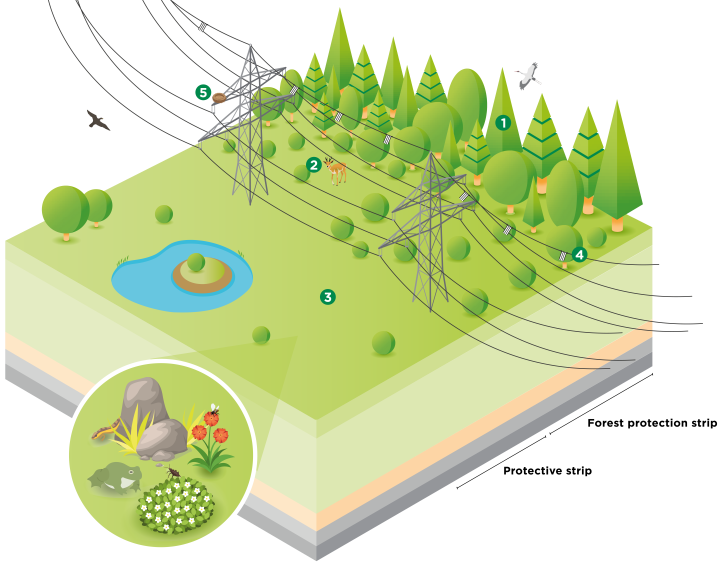
Through ecological route management, Amprion creates new habitats along the transmission lines. These are interconnected along our extensive transmission network. This creates a networked biotope complex that prevents species from becoming isolated and promotes their development. For us, species protection also means safeguarding animals whilst our overhead lines are in operation.
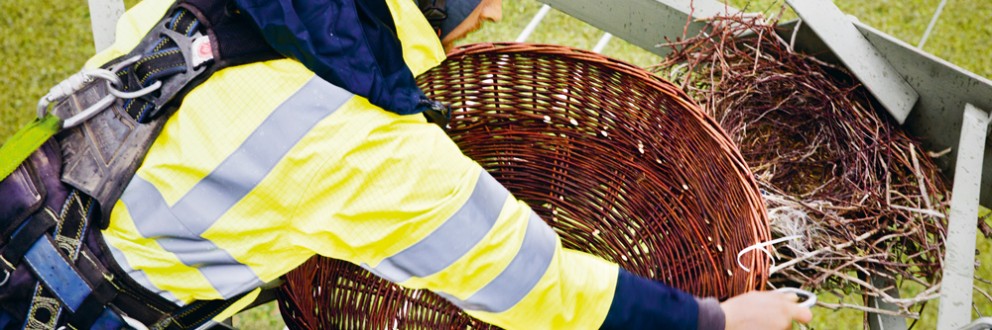
As bird protection is a key priority for us, we have launched our own bird protection programme in collaboration with experts. This has resulted in measures that are now an integral part of our overhead line management. Thanks to bird protection markings on the ground wires above the conductor wires, for example, we can reduce the collision risk for certain species by up to 90 per cent locally. We also equip suitable sections of the power lines with nesting aids.
To ensure effective bird protection, we collaborate with environmental organisations as key technical partners. Together with other grid operators, we support, for example, the ‘Portal Vogelfund und Stromleitung’ (Bird Sightings and Power Lines Portal), which is operated by the Nature and Biodiversity Conservation Union (NABU) on behalf of the Renewables Grid Initiative. This marks the first time that grid operators and NABU have jointly analysed data. In 2022, the project was extended by a further three years until 2025.
In addition, Amprion is converting unused areas at substations into species-rich flower meadows. Through the variety of plant species, we are creating a wide range of habitats for insects, thereby increasing biodiversity in these areas.