Grid booster in Bavarian Swabia: innovation and cooperation for a secure electricity grid
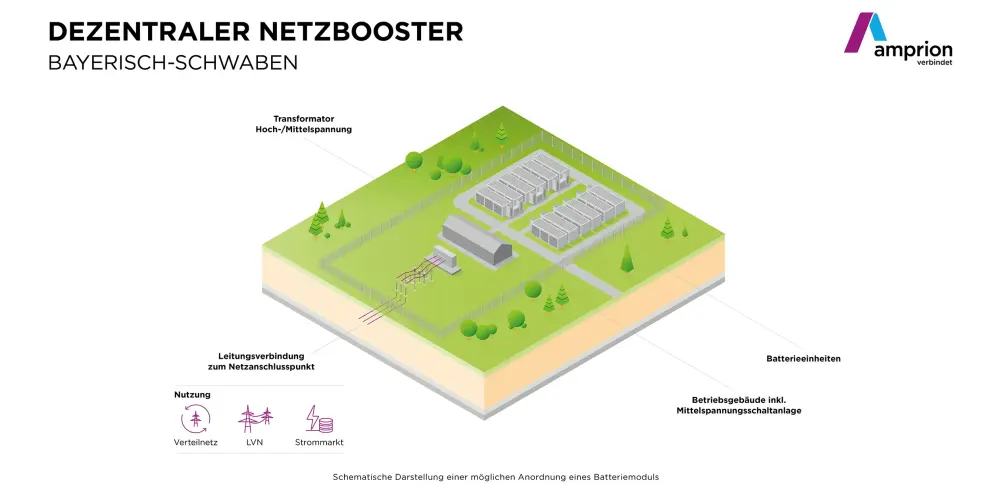
Contract awarded: a project company recently founded by EDF power solutions Deutschland GmbH will construct and operate the decentralised grid booster in Bavarian Swabia. The project is the result of an innovative collaboration between Amprion, E.ON and LEW Verteilnetz (LVN) with the aim of relieving the pressure on the electricity grid during bottlenecks, maintaining stability and cutting costs.
Grid boosters are large-scale battery storage units that can be activated within seconds. They enable grid bottlenecks to be resolved at short notice and power lines to be utilised more efficiently, even during normal operations. As a result, fewer interventions are required to control grid capacities, thereby reducing the high cost of these interventions, also known as redispatch costs. Decentralised grid boosters consist of a network of battery modules located at several points in the grid.
Multiple uses: innovation for greater profitability
The project in Bavarian Swabia, which is due to go into operation on 1 January 2028, has an innovative unique selling point within Germany: if the grid booster is not needed to stabilise the transmission grid, LEW Verteilnetz can also utilise it to relieve pressure on the regional electricity grid system. Its uses are to be regulated under the terms of a cooperation agreement between the grid operators. During the summer months, EDF power solutions Deutschland is also permitted to offer the battery storage systems on the electricity market, thus tapping into a third source of revenue. These multiple uses optimise the economic benefits of the pilot project.
Amprion has now awarded the operation of the decentralised grid booster with a total of five battery modules to EDF RE Speicherprojekte 1 GmbH & Co. KG, a new project company recently founded by EDF power solutions Deutschland GmbH, which is based in Leinfelden-Echterdingen. The project involves detailed planning of the specific battery locations, obtaining approval and constructing the battery modules.
“We are delighted that the awarding of the grid booster marks another key milestone in the project. The multiple usage of battery storage facilities – in the market, in the distribution grid and in the transmission grid – is unique in Germany to date,” says Amprion CEO Dr. Christoph Müller. “This project is providing us with vital experience when it comes to designing future battery storage operating concepts. Moreover, the grid booster has an economic benefit, as it helps to reduce the cost of managing bottlenecks.”
“EDF power solutions Deutschland is delighted to have been entrusted with the contract to build and operate the decentralised grid booster – one of the largest infrastructure projects currently underway in Germany’s energy sector. Our Group Management Board and the German team also look forward to working closely with the Amprion project management team to put our joint expertise in the field of large-scale battery storage at the service of the energy transition, providing urgently needed flexibility and vital grid control capacities to the German electricity grid,” adds Johnathan Fraser, CEO of EDF power solutions Deutschland GmbH.
“With the grid booster, we are setting new standards together. The innovative way in which the storage facility operates increases grid security and reduces costs for our customers,” says Dr. Thomas König, E.ON board member responsible for energy networks.
“A sustainable, secure and affordable energy transition: the grid booster will contribute to this common goal, as it helps make best possible use of existing power lines and transformers and avoid grid bottlenecks,” says LEW CEO Dr Malte Sunderkötter. “We look forward to moving on to the next phase together with our project partners.”
The grid booster, which will provide a total output of 250 megawatts, is being built in the vicinity of the existing substations in Gersthofen, Irsingen, Memmingen, Oberottmarshausen and Vöhringen. At these grid connection points, the battery modules, each with a capacity of 50 megawatts, will be connected to LVN’s regional 110-kilovolt distribution grid.
Last year, the Federal Network Agency confirmed the need for the grid booster in its 2037/2045 Electricity Grid Development Plan, version 2023.
For press enquiries, please contact: