New hub for wind energy: Construction of the A-Nord converter in Emden is progressing rapidly
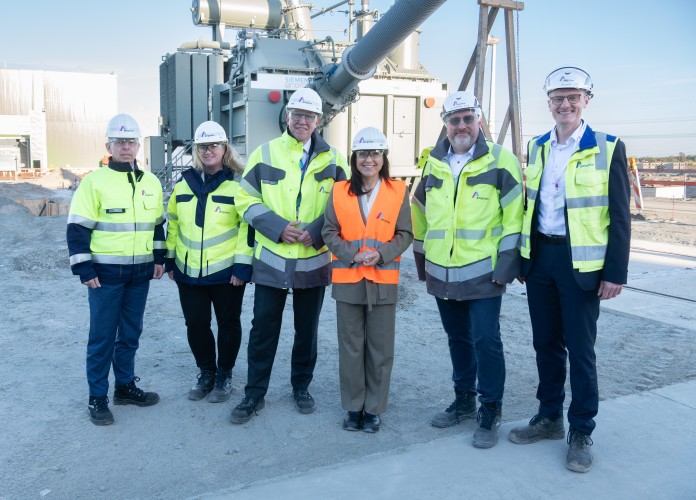
Starting in late 2027, electricity is expected to be transmitted from Emden to North Rhine-Westphalia (NRW) to supply two million people with wind energy. As part of the National Maritime Conference, Katherina Reiche, Federal Minister for Economic Affairs and Energy, recently visited the converter station in Emden.
Work on the Emden-Petkum converter station is proceeding according to plan. Key installation work has been completed. The 13 transformers, each weighing around 300 tons, are already on site and will be connected shortly. In addition, the installation of the power electronics in the converter halls is currently underway. During the National Maritime Conference in Emden, Federal Minister Katherina Reiche took the opportunity to visit the converter station under construction in Emden.
The facility is a key hub for distributing wind energy from the north. In the future, large quantities of green electricity from wind farms in the North Sea will arrive in Emden. The electricity will then be transported further to Meerbusch-Osterath via the 300-kilometer-long A-Nord underground cable connection. This will enable approximately two gigawatts of wind power to be delivered to North Rhine-Westphalia.
The Emden converter station is among the most modern of its kind. In the future, the facility will convert alternating current into direct current. In addition, it regulates and stabilizes the grid voltage. Together with the Ultranet direct current connection, this creates a wind power corridor approximately 600 kilometers long extending all the way to southern Germany. A total of around four million people in Germany will benefit from this corridor.
Federal Minister Katherina Reiche: “The converter in Emden is a key project for grid expansion in Germany. Only with high-performance power grids can we reliably transport wind power from the north to where it is needed — to the people and to industry. Projects like A-Nord create exactly this connection and enhance supply security. Construction progress shows that we are making headway with grid expansion—and that is crucial for a stable and efficient energy system.”
“Ultranet and A-Nord are creating Germany’s first multi-terminal system. This will strengthen the German power system in a sustainable way,” said Amprion CEO Dr. Christoph Müller. “Over the next three years, Amprion will commission one major transmission line project annually. This will allow us to reliably supply consumption centers in western and southern Germany with wind energy and reduce the costs of grid bottlenecks by around 700 million euros per year. This will provide noticeable relief for electricity customers,” added Müller.”
Offshore Planning at Amprion
Amprion is investing approximately 42 billion euros by 2030 in the expansion of the transmission grid and, thereby, in Germany’s energy transition. This includes several high-capacity onshore and offshore projects using direct current technology, which Amprion is coordinating. This approach saves time and costs and minimizes the impact on nature and the environment.
The offshore grid connections will extend far inland to major consumption centers, ensuring that wind power reaches exactly where it is needed most. Additionally, converter platforms at sea will be interconnected with one another and with European partners. Amprion is currently implementing offshore grid connections in the DolWin4, BorWin4, BalWin1 and 2, Windader West, and Rhein-Main-Link projects.
Wind Energy “Made in Europe”
To ensure that every cable and every platform functions reliably, Amprion relies on European manufacturing partners for its offshore grid connections wherever possible. With shared standards, short supply chains, and extensive experience at sea, this approach makes a significant contribution to a sustainable power supply for Europe.
This is how the individual steel blocks for the converter platform are built in Papenburg. The electrical engineering for the converters is developed in Nuremberg, the steel blocks are assembled into a platform in Cádiz (Spain), and the steel substructure comes from Norway. Amprion sources the cable technology from Gron (France), Pikkala (Finland), and Naples (Italy).
Dr. Carsten Lehmköster, Managing Director of Amprion Offshore GmbH; Tanja Groß, A-Nord Project Spokesperson; Dr. Christoph Müller, CEO of Amprion GmbH; Katherina Reiche, Federal Minister for Economic Affairs and Energy; Michael Hegmanns, A-Nord Converter Project Manager; Dr. Daniel Eichhoff, Head of HVDC (from left to right)