Substations

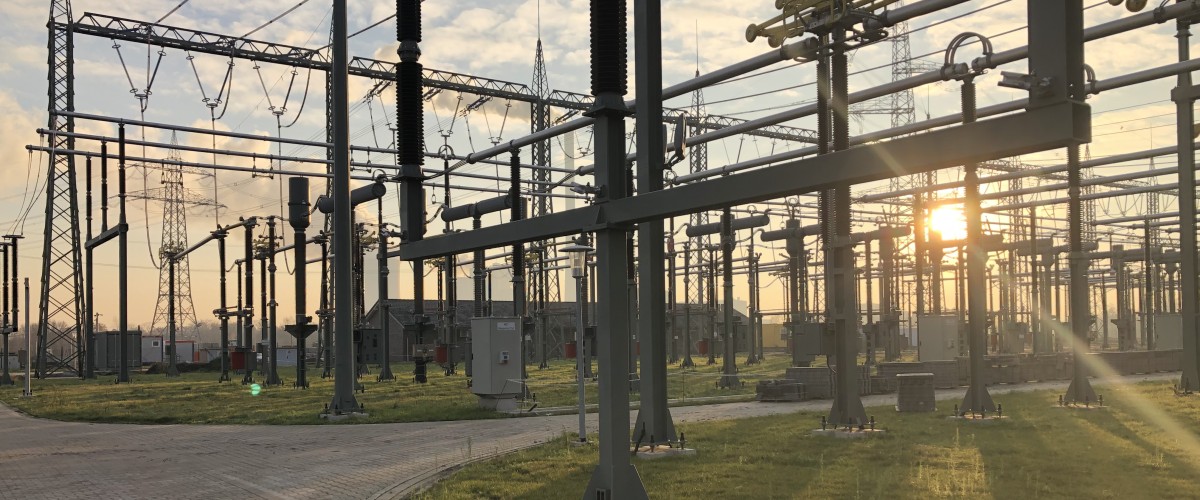
Die Fotografie zeigt das Innere einer weitläufigen Schalt- und Umspannanlage, die ein wichtiger Knotenpunkt im Stromnetz ist. Das Bild wurde im Querformat aufgenommen und fängt die Szene während der goldenen Stunde ein, mit warmem Licht von der tief stehenden Sonne. 
Vordergrund: Eine befestigte Zufahrt und grasbewachsene Flächen führen durch die Anlage. Die Infrastruktur wird von vielen hohen, grauen Metallpfosten und Trägersystemen dominiert.
Mittelgrund: Verschiedene elektrische Komponenten sind zu sehen, darunter Isolatoren, Schaltanlagen, Transformatoren und Steuersäulen. Im rechten Bereich scheint die Sonne direkt durch die Stahlkonstruktion eines Mastes hindurch und erzeugt starke Lichtstrahlen und Schattenwürfe.
Hintergrund: Weitere hohe Masten und ein Netz aus Hochspannungsleitungen zeichnen sich gegen den hellen Himmel ab. Im Hintergrund sind links einige niedrigere Gebäude der Betriebsanlage erkennbar. Die Anlage ist von einem Zaun umgeben.

Substations and step-up stations are the hubs of our transmission network. They perform various functions that are critical to the uninterrupted operation of our transmission network. Their main tasks include switching power lines on and off and stepping up electrical energy between different voltage levels.
Substations connect circuits of the same voltage level within a switchgear panel and can switch them on and off. The load flow is precisely controlled and distributed. If a transformer is connected to a switchgear panel, two circuits of different voltage levels can be connected to each other through transformation. In short: Every asset has a switchgear panel, but not every asset has a transformer connected to it.

Stepping Up or Down Voltage – Voltage Conversion

Transformers connect the transmission network to distribution systems, the facilities of large industrial companies, and power generation plants. To ensure that power transmission runs smoothly, the voltage must be adjusted to meet customer requirements. High-performance transformers are responsible for converting electrical voltage—for example, from 380 to 110 kilovolts.

Switching on or off – the switching process

Overhead lines and underground cables converge in our switchyards, where they can be switched on or off needs-basedly and centrally controlled remotely. The technical switching of the circuits is handled by circuit breakers, which ensure the safe disconnection of the electrical current. In the event of a malfunction, parts of the asset or affected lines are automatically shut down.

Our engineers control and perform monitoring of the assets from the grid control centers in Rommerskirchen, Hoheneck, and the main control centre in Brauweiler near Cologne. They receive measurement data from all assets, which provides information on, among other things, how heavily individual lines are loaded. This data allows us to ensure that electricity reaches its destination without overloading our grid. We also perform monitoring of voltage levels and frequency and adjust them needs-basedly.

The Design of a Substation

All of our substations are standardized and modular in design. This standardization is based, among other things, on VDE 0101. The modular design ensures the efficient construction and operation of our assets. The necessary switchgear and measuring equipment are arranged close together within a switchgear panel, for example for lines and transformers. Busbars and couplings connect individual switchgear panels to one another. From a technical standpoint, this constitutes a switchgear system. Specifically, an asset consists of the following essential components:

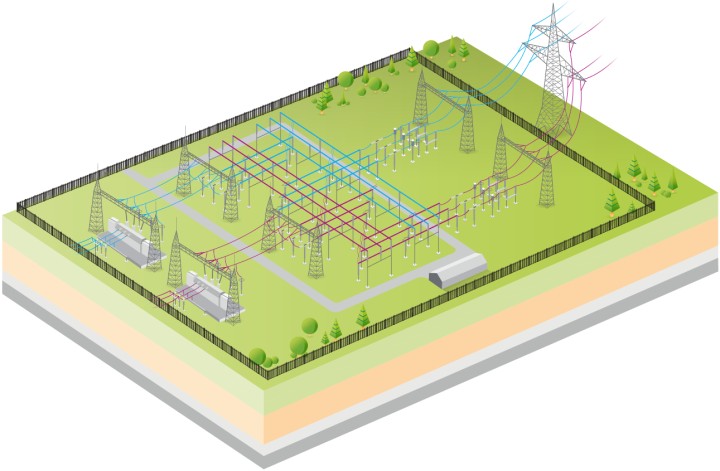
Eine isometrische Illustration eines Umspannwerks. Die Anlage ist von einem Zaun umgeben und enthält mehrere Hochspannungsmasten, Transformatoren und Stromleitungen in verschiedenen Farben (blau und rot), die unterschiedliche Stromkreise darstellen. Die Leitungen verlaufen von den Hochspannungsmasten über Isolatoren und Verteilerstrukturen. Es gibt zwei große graue Transformatorstationen sowie kleinere Gebäude. Das Gelände ist grün, mit Bäumen und Sträuchern an den Rändern.
+
+
+
+
+
+
+
+
+
Transformer

Did you know?

The transformers in our substations convert voltage from, for example, 380 to 220 or 110 kilovolts. Distribution system operators use this voltage to transmit the electricity further, then step-down the voltage in stages to the voltage level required by the end user, such as 230 volts. Today’s largest transformers have an electrical demand of up to 600 megavolt-amperes and weigh up to 450 tons.

Stilisierter Schuko-Stecker

Invisible but crucial: Reactive power for stable grids

Today, our assets also perform a key function: they stabilize the mains voltage. To do this, alternating current requires reactive power—simply put, an accompanying energy that enables the constant creation and dissipation of electric and magnetic fields. This energy does not reach households and businesses as useful energy, but it places a load on the lines and reduces the amount of active power that can be transmitted.

In the past, reactors at large power stations were the primary source of reactive power. With the energy transition, many of these power stations are being taken off the grid, while demand is rising because ever-greater amounts of power are being transmitted over long distances. Amprion is therefore increasingly installing reactive power compensation systems.
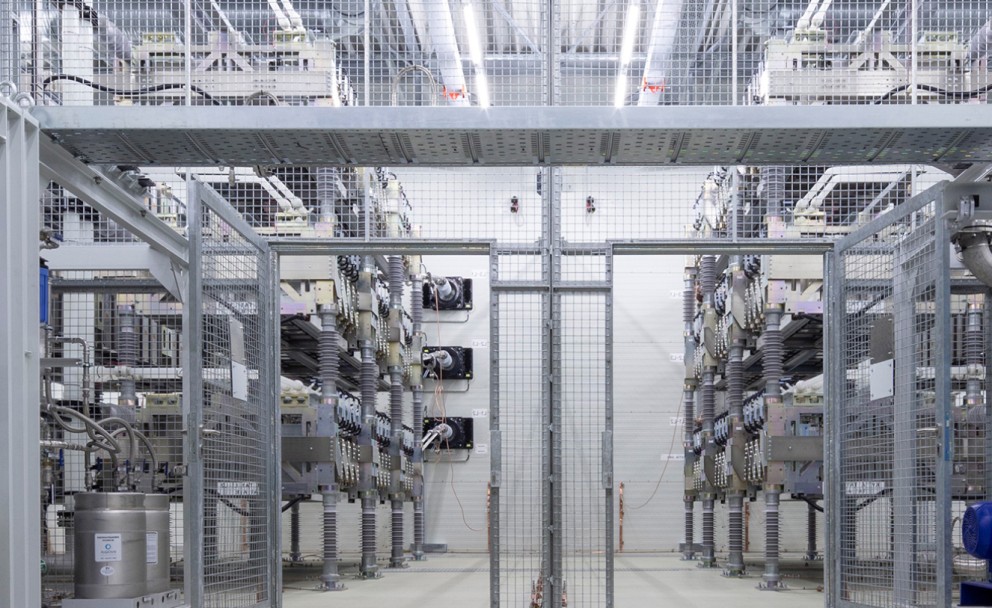
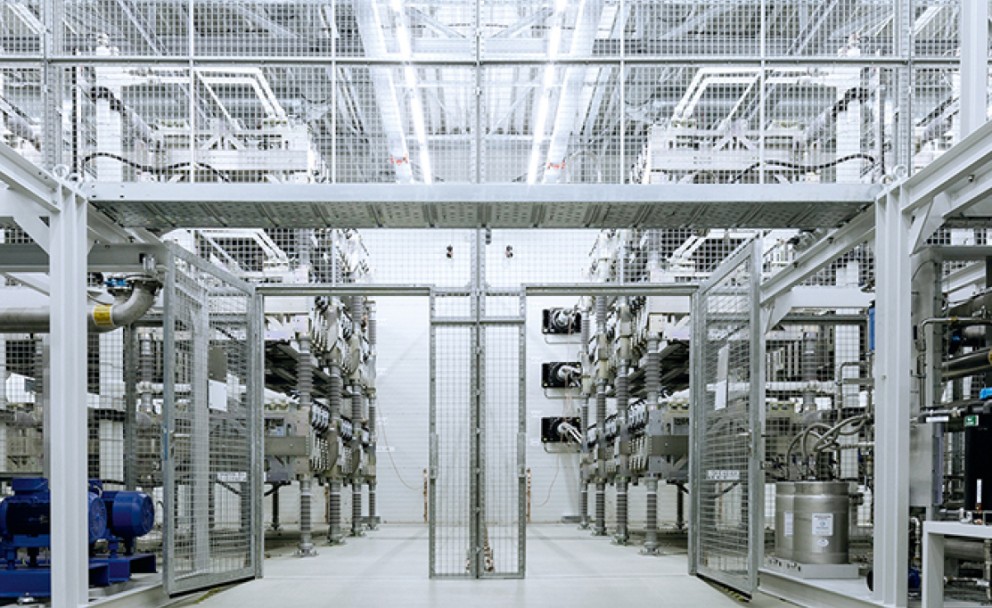
Eine Nahaufnahme des Innenraums einer technischen Anlage mit mehreren parallel angeordneten Schaltschränken und Hochspannungskomponenten. Die Konstruktion ist mit Sicherheitsgittern versehen, während Kabel und Metallstrukturen das Bild dominieren.
Shunt Reactors and MSCDNs

Static compensation systems include shunt reactors, which are installed in many Amprion substations. Modern versions are tap-adjustable and resemble transformers. They reduce excessive bus voltage; if the voltage is too low, MSCDN capacitor banks provide compensation.

Ein Innenraum einer technischen Anlage mit hohen, metallischen Gestellen, die mit elektrischen Komponenten bestückt sind. Ein engmaschiges Schutzgitter trennt den Gang von den Installationen. Die helle Beleuchtung betont die komplexe Verkabelung und technischen Systeme.
STATCOM Systems

STATCOM Systems STATCOM systems are power electronics-based systems for dynamic voltage regulation in the grid. They maintain a stable voltage level by supplying or absorbing reactive power steplessly and very rapidly.

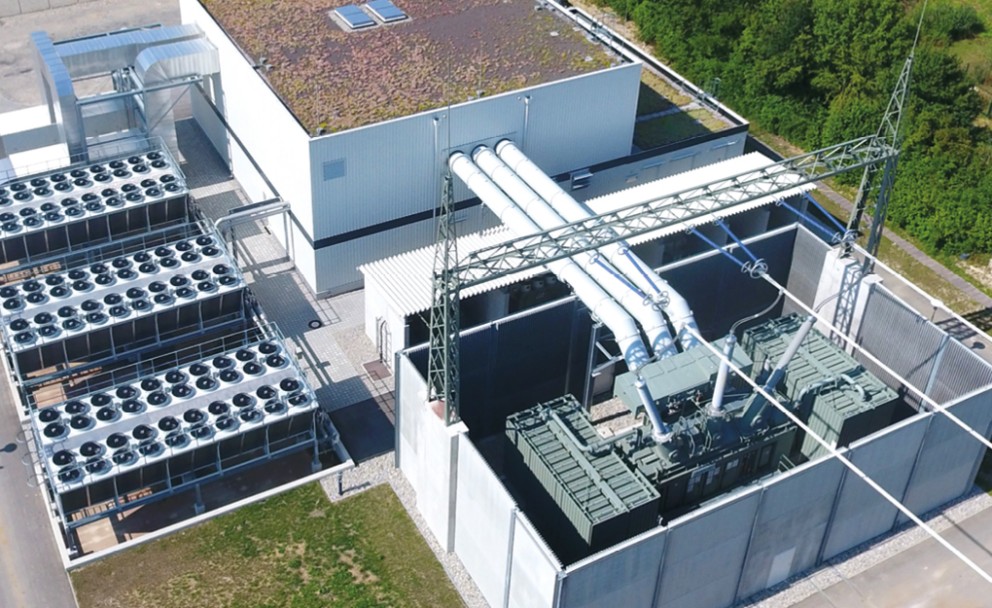
Eine Luftaufnahme einer industriellen Anlage mit einem großen, weißen Gebäude mit begrüntem Dach. Daneben befinden sich mehrere große Kühlanlagen mit Ventilatoren. Im Vordergrund sind massive Transformatoren und Hochspannungsleitungen zu sehen, die in eine Umspannstation führen.
Synchronous Condensers

A synchronous condenser is similar in design to a conventional synchronous generator, but is driven not by a turbine, but by the electrical grid. As a synchronous machine, it can supply or absorb reactive power, thereby supporting the voltage in the transmission network.

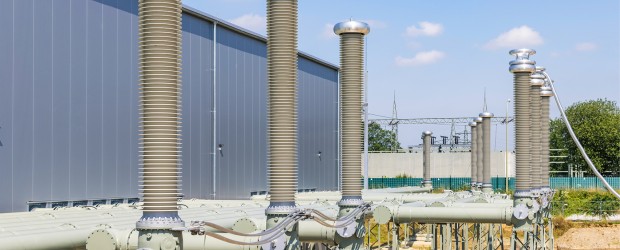
Das Bild zeigt eine Außenansicht einer Umspannanlage oder eines Elektrizitätswerks. Im Vordergrund sind mehrere hohe, säulenartige Isolatoren und dicke Kabelstränge in einem hellgrünen bis grauen Farbton zu sehen. Dahinter erstreckt sich ein großes, graues Gebäude mit einer strukturierten Fassade. Im Hintergrund sind weitere Elemente der Anlage erkennbar, wie Metallgerüste und elektrische Leitungen. Der Himmel ist blau mit einigen weißen Wolken.

Gas-Insulated Substations

A small portion of our substations are gas-insulated substations (GIS). Compared to traditional outdoor substations, this is an alternative design that is installed and operated exclusively at sites that offer a significant advantage over alternative locations and where space constraints preclude the use of an outdoor design.

SF6 – A Safe Insulating Gas That Deserves Special Care

SF6 is the gas most commonly used in gas-insulated switchgear—a colorless, odorless gas that is non-toxic, non-flammable, and poses no danger to humans or animals. For this reason, it is not classified as a hazardous substance. However, SF6 has a high global warming potential. It is therefore particularly important for us to handle it responsibly.

We ensure that

  • the gas is used only in fully enclosed, gas-tight assets,
  • we document and consistently minimize emissions,
  • our assets detect leaks early,
  • and our technical staff is trained and certified.

Alternative Gases

Our Path to the Future

To further optimize our assets and reduce their environmental impact, we are continuously testing alternative gases. We implement these as soon as they are technically mature, thoroughly tested, and operationally reliable. As early as 2018, a pilot project involving 245-kV voltage transformers using synthetic air was put into operation. In addition, current solutions are being developed that will allow parts of 380-kV GIS assets to be insulated with synthetic air over the next few years. In addition to synthetic air, another alternative gas is currently available for GIS in a gas mixture containing the fluorinated insulating gas fluornitrile.

Piktogramm einer Flamme, die Feuer, Gas, Wärme oder Brennbarkeit symbolisiert.

Load Flow Control – Relieving the Load on Power Lines

For several years now, electricity generation from renewable energies has been growing faster than the transmission network. As a result, the transmission network is increasingly reaching its limits. The result is costly interventions in grid operations, known as redispatch. The costs of these interventions are passed on to private households and businesses through grid fees. To ensure that electricity from renewable energies can flow with reliability, Amprion systematically deploys high-performance technologies in the grid, including phase-shifting transformers. With their help, grid operators can control the path that the electricity takes.

What is the operating principle of the Phase Shifting Transformer?

A Phase Shifting Transformer (PST) is operated according to system demand. If, for example, the power flow on a line is too high, grid control engineers reduce the power flow on that specific line by increasing its effective impedance. This is referred to as retard mode. In retard mode, the line is relieved; instead, parallel lines carry a higher share of the power flow. In advance mode, grid control engineers reduce the effective impedance, thereby increasing the power flow on the corresponding line.

What technology is behind this?

In Phase Shifting Transformers — unlike conventional power transformers used for voltage conversion — one winding is connected in series with a circuit. Via the other winding, a quadrature voltage (also referred to as a series injected voltage) is introduced into the circuit. The magnitude and direction of this quadrature voltage influence the effective impedance and thus the power flow of the circuit. Otherwise, the design and physical size of the different transformer types are nearly identical.

How are installation and operation carried out?

Many lines in our transmission network carry two parallel circuits operating at the same voltage level. Wherever we, as the transmission system operator (TSO), need to control power flows, we install two Phase Shifting Transformers accordingly — one per circuit. During the installation of Phase Shifting Transformers, we implement special acoustic mitigation measures, for example through fully enclosed, maximum-attenuation housings.

Playing it safe – Redundancies

Today, we work with innovative technologies and circuit designs, which includes operating assets with multiple busbars: This allows us to create reserves or redundancies and provides us with multiple options for connecting the incoming and outgoing power lines within the asset. This flexibility increases reliability and safety, because in the event of a fault, we can switch to a reserve busbar and route the power via an alternative path.

At the same time, the flexible interconnection allows us to control the flow of electrical energy in the grid within certain limits and to proactively manage individual line sections. Since our switchgear also includes a bypass busbar, we can continue to operate the line without interruption even during maintenance and repair work on the switches.