Structure of an underground cable system

An underground cable system consists of many components—the underground cables themselves, as well as, for example, cable joints, cable transfer stations, monitoring stations, and, in the case of AC voltage, compensation systems that compensate for reactive power.
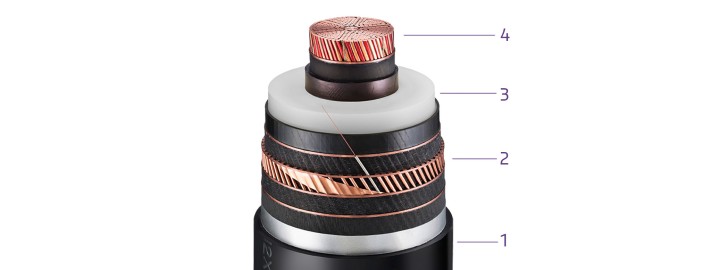
Querschnitt eines Hochspannungskabels mit vier nummerierten Schichten: äußere Schutzummantelung, Kupferabschirmung, weiße Isolierung und zentraler Kupferleiter mit segmentierter Struktur.

1. Cable sheath – Protects the cable, against moisture in particular
2. Wire screen – Controls the electric field and discharges fault currents
3. Insulating layer – Insulates the electric conductor
4. Electric conductor – Conducts the current

Underground cables as a transmission medium

Underground cables essentially consist of an electrical conductor, an insulation system, a wire shield, and a cable sheath. Inside is the live electrical conductor—in the case of extra-high voltage, this is made of copper. It is surrounded by an insulation system, the main component of which is plastic. The insulation itself is usually made of polyethylene (PE), which is cross-linked into so-called VPE through a thermochemical process. An outer copper wire shield diverts fault currents and contains the electric field within the cable. The outer cable sheath protects the cable from moisture.

Joints as Connectors

Due to transportation logistics, extra-high-voltage cables can currently only be delivered to the construction site in sections ranging from approximately 1,000 to 1,300 meters in length. Bridges and other structures impose limitations on the transport of these heavy cable drums. We must therefore connect the cable sections using joints during installation. To allow for measurements when necessary, the connections on some joints are accessible from the outside. These so-called grounding joints are required at specific intervals along the cable connection as above-ground maintenance facilities.

Cable Transfer Substation for Grid Connection

We construct cable transfer stations at points where cables enter or exit the ground. In AC distribution systems, they are necessary to connect overhead lines and underground cables. Such a substation resembles a small substation. In AC networks, longer cable sections also require choke coils to compensate for reactive power. These require additional switching devices, thereby increasing the space requirements of the entire cable transfer station.

Cable-to-Cable Transfer Station

When constructing long DC underground cable connections, cable-to-cable transfer stations are installed along the entire line at intervals of approximately 140 kilometers. These assets enable the operation and effective monitoring of the DC cable line. In addition, in the event of a fault, they can locate the cause within the individual line sections. To do this, the underground cables are temporarily brought to the surface at the cable-to-cable transfer substations. The substations essentially consist of cable terminations, insulators, and surge arresters.

Monitoring Station

Monitoring stations are required along DC underground cable systems, depending on the length of the line. These are necessary to amplify signals for monitoring the line. Additional companion cables, known as optical fibre cables (OFC), are laid in the cable trenches. The OFCs are routed to a monitoring station. They are used, among other things, for monitoring the lines, such as for temperature measurements. Since the signals weaken along the route, they must be amplified at regular intervals.