Construction process and recultivation
Es folgt eine Bildbeschreibung:
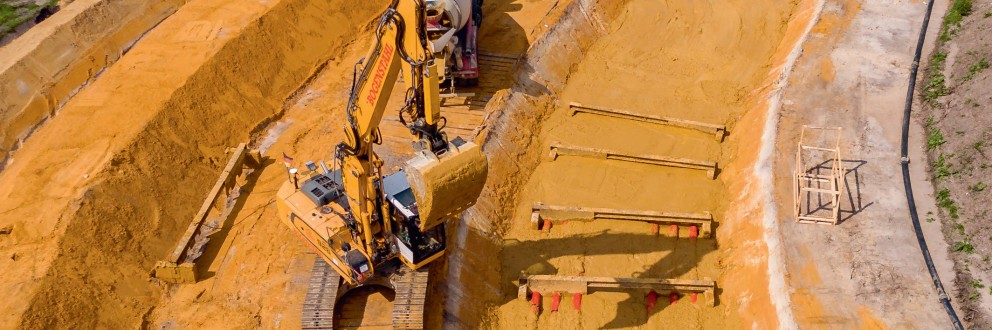
Die Luftaufnahme im Querformat zeigt einen Bagger, der auf einer Erhebung zwischen zwei Erdgräben steht.
Ende der Bildbeschreibung.

Site Investigation

Underground cable projects require particularly detailed information about soil conditions. The site investigation (BGU) is a process designed to gather information about the soil as a foundation. With knowledge of the soil’s properties, bearing capacity, and other relevant characteristics, we can plan our projects. Soil samples are collected through drilling and probing, analyzed in the laboratory, and data on the nature and composition of the construction site and its soil layers is gathered. The results are incorporated into a soil report. This allows us to plan or adjust the route of a corridor and decide on suitable construction methods. The soil science experts who oversee our underground cable projects use the results of the BGU to conduct a soil-related site assessment for a soil protection plan before, during, and after the construction phase.

Open-cut construction

Whenever possible, Amprion installs underground cables using the open-cut method. This method offers the greatest flexibility, allowing us to adapt to local requirements. Open-cut construction also significantly reduces land use and the impact on third parties. Furthermore, it is more time- and cost-efficient, making it the most cost-effective solution in most cases.

Cable Bedding

In open-cut construction, excavators first remove layer after layer of soil and pile it separately to the side of the cable trench. At a depth of about one and a half to just under two meters, depending on the project, we then lay cable ducts for the cables, which will later be pulled through in stages. At the connection points—that is, the joints—we keep the excavation open and pull the cables into a protective conduit section by section. This allows us to replace a damaged underground cable in specific locations without having to dig up the entire line. Additionally, the protective conduit provides extra protection against mechanical damage.

Use of Liquid Soil

During the construction of cable conduit systems, temporarily pourable, self-compacting filling materials (TPFM)—also known as liquid soil—are typically used to bed the conduits. In the cable trench, both below and above the cable systems, the so-called “conduit zone” is filled with this bedding material. Above the conduit zone, the existing soil is reinstalled.

Properties of Liquid Soil

When excavating a cable trench, the bedding for the protective conduits must be uniformly compacted, sufficiently load-bearing, and free of sharp-edged material. The bedding must also be dimensionally stable over the long term to counteract subsequent settlement or differential settlement and thus prevent undesirable deformation of the cable conduit system. Furthermore, it should not exhibit increased drainage potential relative to the surrounding soil. The liquid soil should also ensure increased thermal conductivity of the soil, thereby helping to prevent potential overheating of the power cable.

Production of Liquid Soil

Since the excavated soil found in the pipeline zone is preferably used and processed on-site for the liquid soil, CO₂ emissions and waste disposal are reduced.

The liquid soil is free of environmentally harmful substances and poses no risk to soil or groundwater. The excavated soil found on-site can be used as the main component for the liquid soil, provided it is suitable. Only in locally limited areas where the excavated soil is not suitable for producing liquid soil are graded sands used instead. Secondary components include layered silicates and cement at ≤ 5% by weight. Water is added to regulate the flowability.

Water Permeability of Liquid Soil

The water permeability of liquid soil is roughly equivalent to that of a silty-cohesive soil. Thanks to its good capillary action, water can also be transported from deeper layers. The liquid soil does not dry out because it has excellent water retention capacity. The liquid soil is transported to the construction site and installed using “truck mixers.” These vehicles resemble concrete mixers but contain liquid soil rather than concrete.

Backfilling and Reclamation

The cable trench is backfilled in the same order as the excavation—from the bottom layer to the top. To minimize soil settlement and prevent the formation of voids, we backfill the soil using the finest-grained material possible. For this, the soil must be dry—wet weather can delay construction work accordingly. Afterward, the various layers are restored to a state nearly identical to that before the work began: the soil structure is preserved, and rapid regeneration is ensured. A soil scientist oversees and conducts monitoring of the construction and reclamation.

Closed construction

Open-cut construction is not always the method of choice. When we use underground cables to cross bodies of water or roads, closed-tunnel construction—which is significantly more costly and time-consuming—offers advantages. We only need space for the construction site at the starting and ending points of such a route. Various methods are available, such as pilot pipe jacking, flush drilling, or microtunneling. The method we choose depends on the local geology and the length of the route.

The Various Options

There are various methods of trenchless construction. These include horizontal directional drilling (HDD) and hydraulic pipe jacking, each available in different versions tailored to local conditions. Various drilling methods are available for this purpose, which are carefully selected based primarily on soil conditions and technical parameters (e.g., length of the route).