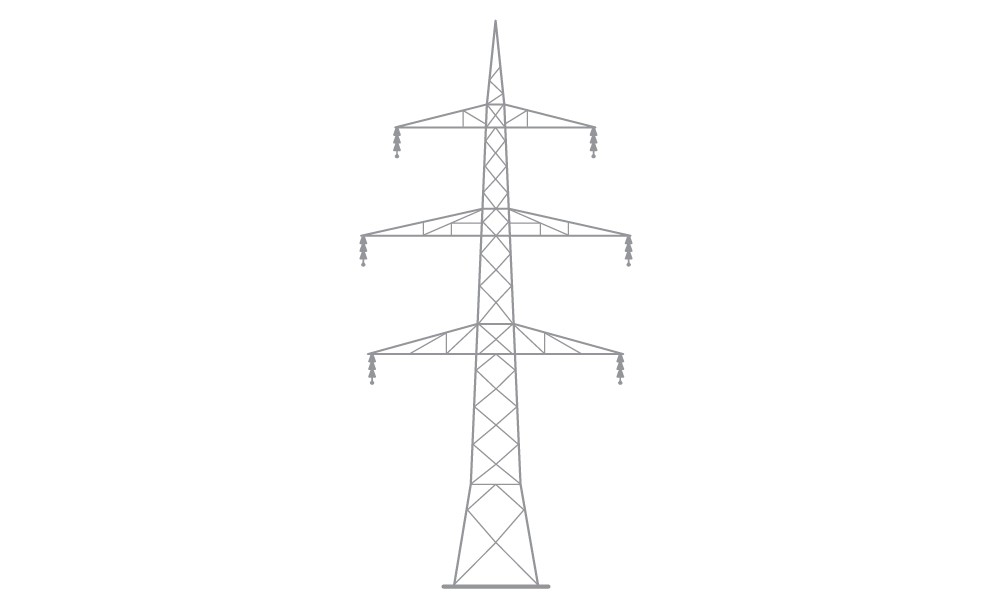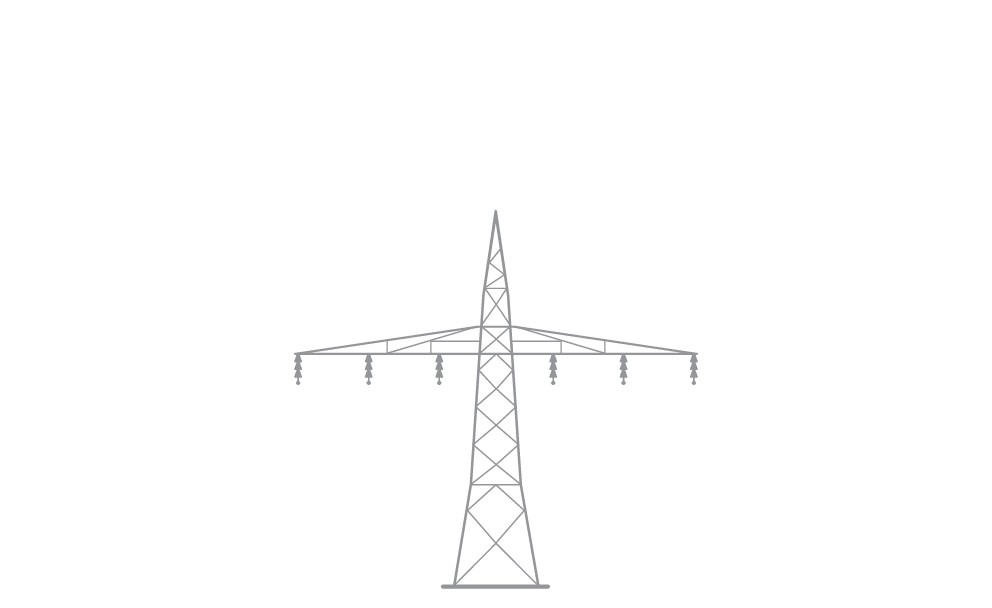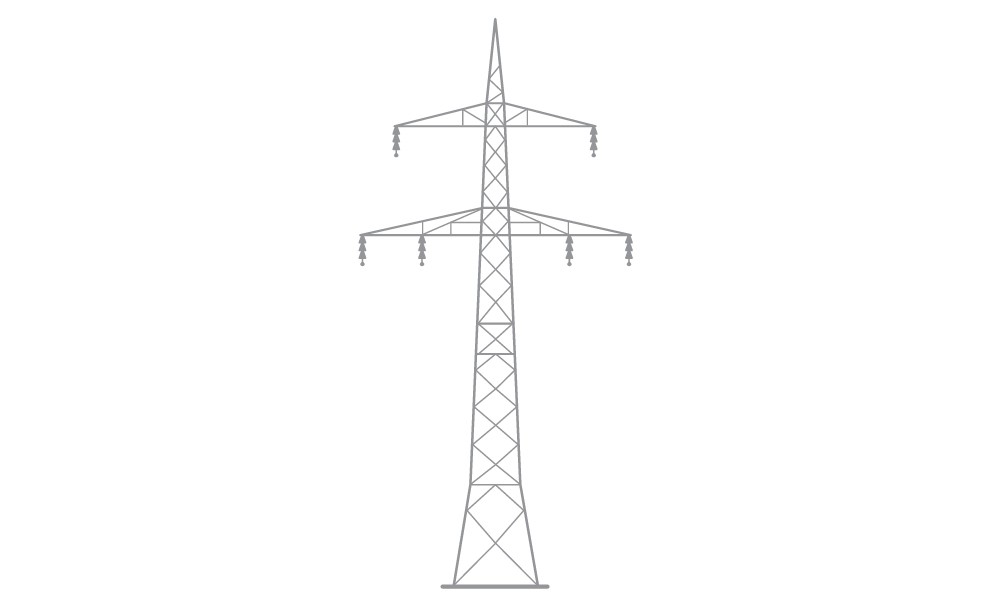
Overhead line
Important elements of our network are the overhead lines and the 20,000 or so pylons that carry the conductor cables. These are usually positioned 300 to 500 metres apart. The pylons are for the most part built as steel lattice masts – a proven and cost-effective design that has consequently established itself as the global standard.
THE CIRCUITS AND CROSS-ARMS
A typical pylon has one or more transverse members – what we call the “cross-arms”. Attached to these are insulators, to which conductor cables are in turn secured. It’s through these cables that the electricity flows. As a rule, they are reinforced conductors comprised of a steel core and an aluminium sheath, which have different cross-sections depending on their transmission capacity. 380 kV lines typically use a “quad bundle” made up of four conductors for each phase. Each power circuit has three phases. As a rule, a pylon carries several circuits.
Today, the insulators are manufactured from polymer, but most are made of porcelain, or also toughened glass or ceramic. They separate the high voltages in the overhead conductors from the earthed pylons and prevent the current from being conducted from the conductors to the pylons. An earth or “guard” wire is run between the tops of the pylons to protect the live conductors against lightning strikes.
Different types of pylon along the cable route
Depending on the function, we basically distinguish between four categories or types of pylon or transmission tower:
- If a pylon is located in the middle of a straight route, we use what are known as straight-line or suspension towers.
- If the line is curved, tension or anchor towers are positioned at the points where the direction changes. Unlike on suspension towers, where the insulators hang vertically from the tower and carry the conductors, the mechanical tension causes the insulators (called “strain insulators”) on anchor towers to align themselves in the direction of the conductor.
- Where power lines intersect, we use branch pylons.
- Termination pylons or terminal towers are erected where a line is fed into a substation.
Three designs: barrel, single-level and “Donau” towers
We use different designs of pylon or tower for our overhead lines depending on the local circumstances: barrel towers, single-level towers and “Donaumasten” or Donau towers. These types of tower differ with respect to their height and the number and length of the cross-arms.